- How many grafts will I need?
- Most patients receive 3,500 to 4,000 grafts in a single procedure, which covers the majority of common hair loss patterns (Norwood 3 to 5). Each graft contains 1 to 4 individual hairs, so 3,500 grafts translates to roughly 7,700 individual hairs. Your specific graft requirement is assessed during your free consultation based on your pattern and goals.
- Does a hair transplant hurt?
- The procedure is performed under local anaesthesia, so you won't feel pain during the extraction or implantation. The anaesthetic injections at the start involve a brief sting lasting around five to ten minutes, which patients consistently describe as the most uncomfortable part of the entire day. After that, most patients watch films, listen to podcasts, or chat with the team in complete comfort.
- How long until I see results?
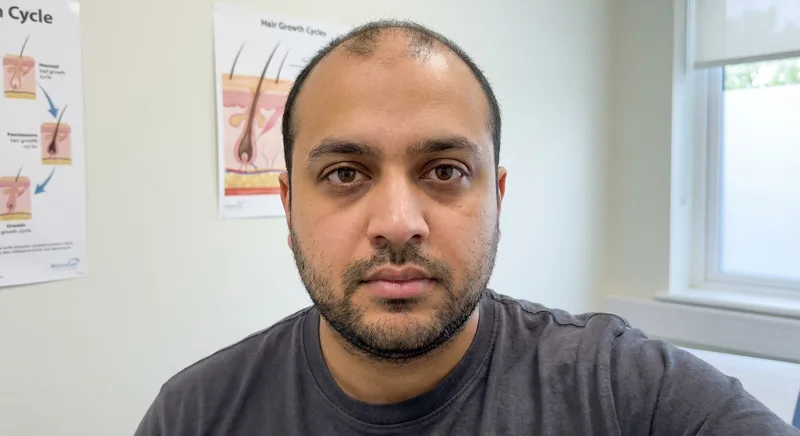
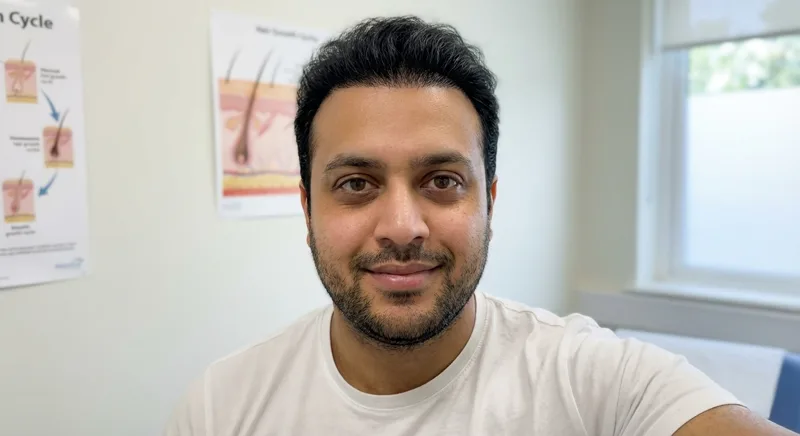
- New hair growth typically begins appearing around month four. By six months, most patients have 50 to 60 percent of their final result visible. The full outcome is reached at twelve months, when a complimentary review appointment documents the complete transformation.
- What is the recovery time?
- Most patients return to work within five to seven days. The scalp heals quickly, with tiny scabs falling away naturally during gentle washing over the first two weeks. Light exercise can resume after two weeks, with full activity by four weeks. The transplanted hair sheds around weeks two to four (this is normal) before new growth begins.
- Is the result permanent?
- Yes. The transplanted follicles are harvested from the back and sides of the head, where they are genetically resistant to DHT (the hormone that causes pattern baldness). Once transplanted, they carry that resistance with them and continue growing permanently in their new location.
- Are there any risks or side effects?
- FUE is a minimally invasive procedure with a strong safety profile. Common, temporary effects include mild swelling (peaks at day 2 to 3 and resolves within a week), scalp redness (fades over two to four weeks), itching during healing, and temporary numbness in the donor area. Serious complications are rare. All risks are discussed in detail during your consultation, and our aftercare team is available throughout your recovery.
- Can women have a hair transplant?
- Yes. FUE hair transplantation is effective for women with suitable donor hair density and a stable hair loss pattern. Women can also benefit from our non-surgical treatments: PRP therapy at £250 per session and Photodiode Therapy (PDT) at £500 for six sessions, both of which are particularly effective for the diffuse thinning pattern common in women.